
The Quarterly Checkup: Q2 2026 Market & VC Landscape
Published on October 8, 2026 · Written by Jason Robertson
Market Overview
(In which the largest initial public offering ever recorded, a change of Federal Reserve chair, and a war that stopped and then started again all arrived inside the same ninety days, and the public markets decided that none of it mattered.)
Q2 2026 gave investors every reason to flinch, and they declined the invitation. A conflict that had taken millions of barrels a day of Gulf oil off the market was still running, the Federal Reserve changed chairs in the middle of the quarter, and the Federal Open Market Committee's own projections flipped from pencilling in a cut to pencilling in a hike. Against all of that the S&P 500 returned 15%, its best quarter since the second quarter of 2020, and the Nasdaq-100 posted its second-best quarterly performance in twenty-five years. Breadth arrived late: small-cap, mid-cap and equal-weight benchmarks reached records only by the end of June. U.S. venture capital recorded the second-largest quarter for deal value in a decade.
The market was pricing AI earnings and AI capital formation, and in the second quarter those two bets paid off together; the war and the Fed barely registered. One analysis circulating after quarter-end noted that stripping out AI and energy names leaves the S&P 500 negative for the year. That is the whole argument in a sentence: the index is not up, a slice of it is up, and the slice is carrying everyone else's return.
The same shape runs through the private market. Anthropic raised USD $65 billion in a single round, USD $15 billion of it committed earlier, more than doubling its pre-money valuation in three months to a post-money of USD $965 billion, above the USD $852 billion OpenAI was valued at on its USD $122 billion round in Q1. AI companies took 86% of U.S. venture dollars in the first half on 43% of deal count, a count share that has barely moved in a year. Dollars are concentrating inside the AI category far faster than the number of AI companies being funded is growing. The concentration story has moved inside the category: a handful of AI companies against the rest of AI.
The exit market told the same story more bluntly. Q2 exit value reached USD $1.8 trillion. Remove SpaceX and the quarter sits where the last four years have sat. A record that one company carries is a record about that company. Even that record has not yet paid anyone: SpaceX's venture holders are locked up until December at the earliest, and one listing does not reopen a liquidity market.
Digital health and Canada each ran smaller versions of the same dynamic: fewer and larger cheques at the top, a narrowing funnel underneath, and an exit window that opens for one name at a time. In digital health that name is Oura, which filed the sector's only registration statement of the year. In Canada it is nobody at all.
The central tension of this quarter is the distance between headline liquidity and effective liquidity. On the headline, 2026 is already the largest exit year ever recorded and fundraising is running at close to a full year's pace in half the time. Effectively, the twelve-month distribution yield to limited partners sits at 12% to 13% of net asset value against a long-run average of 19%, the 2021 vintage has produced the lowest five-year distributions-to-paid-in multiple of this century, and in the newest funds the gains so far belong to the largest ones. Both of those descriptions are accurate at once. Reconciling them is the work of the rest of this report.
U.S. Macroeconomic Landscape
The quarter contained three collisions: an oil shock that spiked and then reversed, a Federal Reserve leadership transition delayed by a Justice Department investigation, and a policy bias that flipped from easing toward tightening. Equities closed out their strongest quarter in six years anyway.
Real gross domestic product grew at a 1.5% annualized rate in Q2, down from 2.1% in Q1, a figure the second estimate on August 26 left unchanged. That is growth after inflation, and in this quarter the distinction carries the argument: nominal output grew 8.0% while the personal consumption expenditures price index rose 5.3% annualized, so most of the quarter's dollar growth was price rather than volume. Consumer spending, investment and exports contributed, offset by a decline in government spending and a rise in imports. Real final sales to private domestic purchasers, which strips out trade and inventory noise, were revised up to 4.2%, more than double the 1.7% of Q1. The headline looks soft and the private-demand core does not; that divergence makes a single quarter a poor guide to anything.
Inflation followed the war almost exactly. The Strait of Hormuz was shut for nearly all of the quarter; an April truce reopened it for only a few days, and a U.S. naval blockade held until mid-June. Headline inflation climbed straight through the truce to 4.2% in May, its highest reading since 2023, with energy up 23.5% over twelve months while core sat at 2.9%. Relief came only in the final two weeks, when a Pakistan-mediated agreement reopened the strait and June prices fell 0.4% on the month, the largest drop since April 2020, taking the annual rate to 3.5%. Two weeks of open water took seven tenths off the annual rate. The improvement was real and almost entirely energy, which makes it reversible in a way that falling core inflation would not be. Anyone extrapolating the June print forward is extrapolating a ceasefire.

Labour softened more on revision than on first release, which is becoming the pattern worth watching. June payrolls printed at 57,000 against a consensus near 115,000, and the following report cut that to 20,000 while trimming May from 129,000 to 63,000, erasing a little over 100,000 jobs after the fact. Unemployment ticked down to 4.2%, but because people left the labour force rather than because hiring picked up. In June alone 720,000 people dropped out, taking participation to 61.5% from 61.8% in May and roughly 62.7% late last year, the lowest since March 2021. Part of that slide is a statistical revision the Bureau of Labor Statistics made in January; the June drop is not.
Consumers kept spending. Retail sales rose 0.2% in June for a fifth straight monthly gain and were 7% higher than a year earlier, though that is a dollar figure, and higher gasoline prices account for part of it. Factories held up as well: the Institute for Supply Management's manufacturing index read 53.3 in June, its sixth consecutive month above the 50 mark that separates expansion from contraction.
The Federal Reserve spent the quarter changing both its chair and its mind. Jerome Powell's last meeting as chair, in April, held rates at 3.50% to 3.75% on the most divided vote since 1992, with the committee split between members who wanted a cut and members who objected to any hint of one. Kevin Warsh arrived in May on the narrowest Senate confirmation in the modern era and ran his first meeting in June. He held rates, shortened the statement and dropped forward guidance, but the committee's projections said what the statement would not. The median expectation for year-end rates rose to 3.8% from 3.4% in March, half the committee now expects at least one hike this year, and all but one member see inflation risk tilted upward. Warsh submitted no projection of his own. A chair who withholds his own forecast while his committee moves toward a hike has said something more specific than guidance would have.
Everything above has since been overtaken in one direction. Headline inflation eased further in July, to 3.4% with core at 2.5%, but the ceasefire did not hold. Fighting resumed on July 8, the U.S. reimposed its naval blockade in early August, and Brent settled at USD $101 on September 9, its highest close since May 22, with American gasoline at a Labor Day record and the Energy Information Administration seeing no return to pre-conflict Middle East output until early 2027. August payrolls then came in at 162,000 against a consensus near 53,000, with unemployment at 4.1%. Futures now put roughly 60% odds on a quarter-point increase at the meeting on September 16, five days after this report reaches you.
For venture, the direction of the projections matters more than the equity return. When the quarter closed, the Federal Reserve had stopped cutting. Within ten weeks it was weighing whether to raise rates. A higher return on risk-free money raises the return every risky asset has to clear, and venture sits at the far end of that line because its payoff is the furthest away. The private valuations set this quarter were priced on the opposite assumption.
I do not expect the adjustment to land evenly. AI rounds are priced on outcomes so large that a point on the discount rate barely moves the arithmetic, and much of the capital funding them is corporate money that is not rate-sensitive in the usual way. Everything else is priced on conventional multiples, competes directly with a Treasury yield, and already carries a smaller step-up. If rates rise and keep rising, the two parallel venture markets I described in Q1 will separate further, and they will do it from below: AI holds its marks for now while the rest of the market is marked down again. The caution is that public investors have already shown they will reprice AI as well; SpaceX and Cerebras both trade well below their highs.
U.S. Venture Capital Landscape
U.S. venture deployment reached USD $413 billion in the first half of 2026, about USD $145 billion of it in Q2. That exceeds the whole of 2025, at USD $319 billion, by nearly 30%, and the previous full-year record of USD $359 billion set in 2021. Q2 on its own was the second-largest quarter for deal value in a decade, behind Q1 2026. A half year that beats the best full year on record should feel like a boom. Nobody describes it that way.

Seven rounds of USD $1 billion or more closed in Q2, together worth USD $87 billion: Anthropic, Project Prometheus, Anduril Industries, Baseten, MiRus, Kalshi and Cognition. Five of the seven went to AI companies. Where sizes are disclosed, Anthropic took USD $65 billion, Project Prometheus USD $12 billion, Anduril USD $5 billion, MiRus USD $1.5 billion and Cognition USD $1 billion, leaving less than USD $3 billion between Baseten and Kalshi. Five companies took 97% of the capital in the quarter's largest rounds.
AI took USD $356 billion in the half, 86% of all venture dollars, against 66% for the whole of 2025, while its share of deal count held at 43%. The number of AI companies getting funded has stopped growing and the dollars going to them have not. I reported 89% for Q1, so Q2 on its own came in lower, the first quarter in this series in which AI's share of dollars has fallen. One quarter does not establish a reversal, and it is worth watching precisely because so much now depends on the answer.
The counterpoint sits in the first-time financing data, the one number this quarter that argues against a narrowing market. An estimated 5,674 companies raised a first venture round in the half, putting the year on pace to exceed 10,000 for the first time. Capital at the very top and at the very bottom is abundant. The middle has thinned: rounds below USD $100 million drew USD $51 billion, or 13% of dollars deployed, down from 33% in 2025 and 44% in 2024. The layer where most companies actually live has lost more than two thirds of its share in two years.
Valuations have now passed their 2021 peaks at every series. Median pre-money valuations for the first half stand at USD $64 million at Series A, USD $188 million at Series B, USD $546 million at Series C and USD $2.0 billion at Series D and later, the last more than double the USD $850 million median of 2025. Every one of those medians is a survivorship figure; the companies that could not clear the bar did not raise at all.
The AI premium is more interesting in shape than in size. At Series A the median AI pre-money of USD $83 million is 1.9 times the non-AI median of USD $44 million; the ratio holds at Series B and narrows to 1.6 times at Series C. At Series D and later it jumps to 6.6 times, USD $4.3 billion against USD $644 million. For most of a company's private life, being an AI company is worth a modest premium. At the top it is worth everything: the premium behaves less like a gradient and more like a cliff at the point where the largest cheques get written, which is precisely where the fewest companies are. Step-up multiples agree: 2.2 times for AI rounds against 1.6 times for everything else.

Geography concentrated along with everything else. Of Q2's roughly USD $145 billion, Bay Area companies drew USD $99 billion across 761 deals, more than twice the rest of the country combined, and USD $492 billion has gone into the Bay Area since the start of 2025. New York, Los Angeles and Boston together added USD $26 billion. So far this year those four hubs have taken 87% of deal value on less than half the deals, and 97% of the value at the venture growth stage. Frontier AI talent is scarce and clustered, capital follows talent, and if that holds then value creation in this cycle stays geographically narrow. The cloud is still located on Earth, and this quarter it settled over the Golden Gate like the fog.
The female founder data extends a concern I have raised for several quarters and it extends it in the wrong direction. Companies with all-female founding teams raised USD $2.9 billion across 383 deals, 0.7% of all venture dollars and 5% of deal count. The dollar figure has fallen three years running, from USD $4.0 billion in 2024 to USD $3.4 billion in 2025 to USD $2.9 billion this half, while total deployment nearly doubled. The headline that companies with at least one female founder took 57% of deal value is arithmetically true and analytically empty: it is driven by Anthropic, OpenAI and Kalshi. Averages make the room look wealthier because one billionaire walked in, and this is the version of that error that gets quoted approvingly.
Non-traditional investors deployed USD $379 billion in the half. Corporate venture took part in only 21% of deals, a decade low, yet those deals carried 83% of deal value, up from 65% in 2025. Crossover investors participated in USD $325 billion of deal value, more than double the whole of 2025, on their lowest deal count since 2019. Both are writing larger cheques into fewer rooms, and the growth-stage companies that relied on crossover money to bridge to an exit are the ones that lose when crossovers get selective.
Exits produced the quarter's headline and its most instructive footnote. SpaceX listed at USD $1.7 trillion, the largest U.S. venture-backed technology listing ever by a factor of seventeen and the largest initial public offering of any kind, raising USD $75 billion before the greenshoe and USD $86 billion after it, with market capitalization moving above USD $2 trillion in early trading. Its Q1 acquisition of xAI at USD $250 billion is the largest acquisition of a venture-backed company on record, and its USD $60 billion purchase of Cursor is second. Q2 exit value came to USD $1.8 trillion and the year to date to USD $2.2 trillion, with listings above USD $1 billion accounting for 81% of all venture exit value this year. One company holds the largest listing on record, the largest acquisition and the second largest, all in the same year.
Part of that total is not what it appears. In Q1 I described SpaceX's USD $250 billion purchase of xAI as a consolidation of two affiliated Musk-controlled assets rather than a third-party exit, and set it aside. In Q2 the same assets returned inside the largest listing on record and were counted again. PitchBook also books SpaceX's full USD $1.7 trillion valuation as exit value, although only about USD $75 billion of stock changed hands. Distributions come from realizable liquidity, and neither transaction has produced any: xAI's investors were paid in SpaceX stock, and Cursor followed the same route when its all-stock sale to SpaceX closed in August.
A marked exit and a realized one are not the same thing, and the ten weeks since quarter-end have made the difference concrete. SpaceX priced at USD $135 on June 11 and closed its first day at USD $161, up 19%, at a market capitalization near USD $2.1 trillion. It touched USD $226 within days, fell as low as USD $108 in late July, and traded around USD $149 on September 10, a third below its high, on a Q2 revenue print of USD $7.8 billion that beat expectations. Pre-IPO investors sit on staggered 180-day lock-ups and insiders on 366 days, so the venture holders whose positions produced this quarter's record exit value cannot sell until December at the earliest. USD $1.8 trillion of exit value was created in Q2. Almost none of it has yet become a distribution.
Cerebras is the footnote and the better guide. The company cancelled a 2025 listing, raised USD $1 billion privately, then went public in May at USD $34 billion, five times the prior year's mark. It opened at USD $385 per share, more than double its offer price, and has since traded below the offer. Of the ten largest U.S. technology listings excluding Cerebras and SpaceX, three finished their first year positive. The window is open for AI, space technology and crypto; it is open narrowly; and the companies going through it are not holding their prices.
Anthropic and OpenAI have both filed confidentially. If they price, the two of them together with SpaceX will generate more value than every U.S. venture-backed exit since 2000. That is a genuine event and it is also, mechanically, three cap tables.
Global Venture Capital Landscape
Globally, venture-backed companies raised USD $227 billion across 8,440 deals in Q2 2026, the second-highest quarterly total ever recorded. The only larger quarter is the one immediately before it: Q1 2026 set an all-time record at USD $333 billion on the back of OpenAI's USD $122 billion round. Q2 came in 32% below that record and 78% above the USD $128 billion of Q2 2025. Two consecutive quarters have each been decided by a single round. The global series is now a measure of two companies.
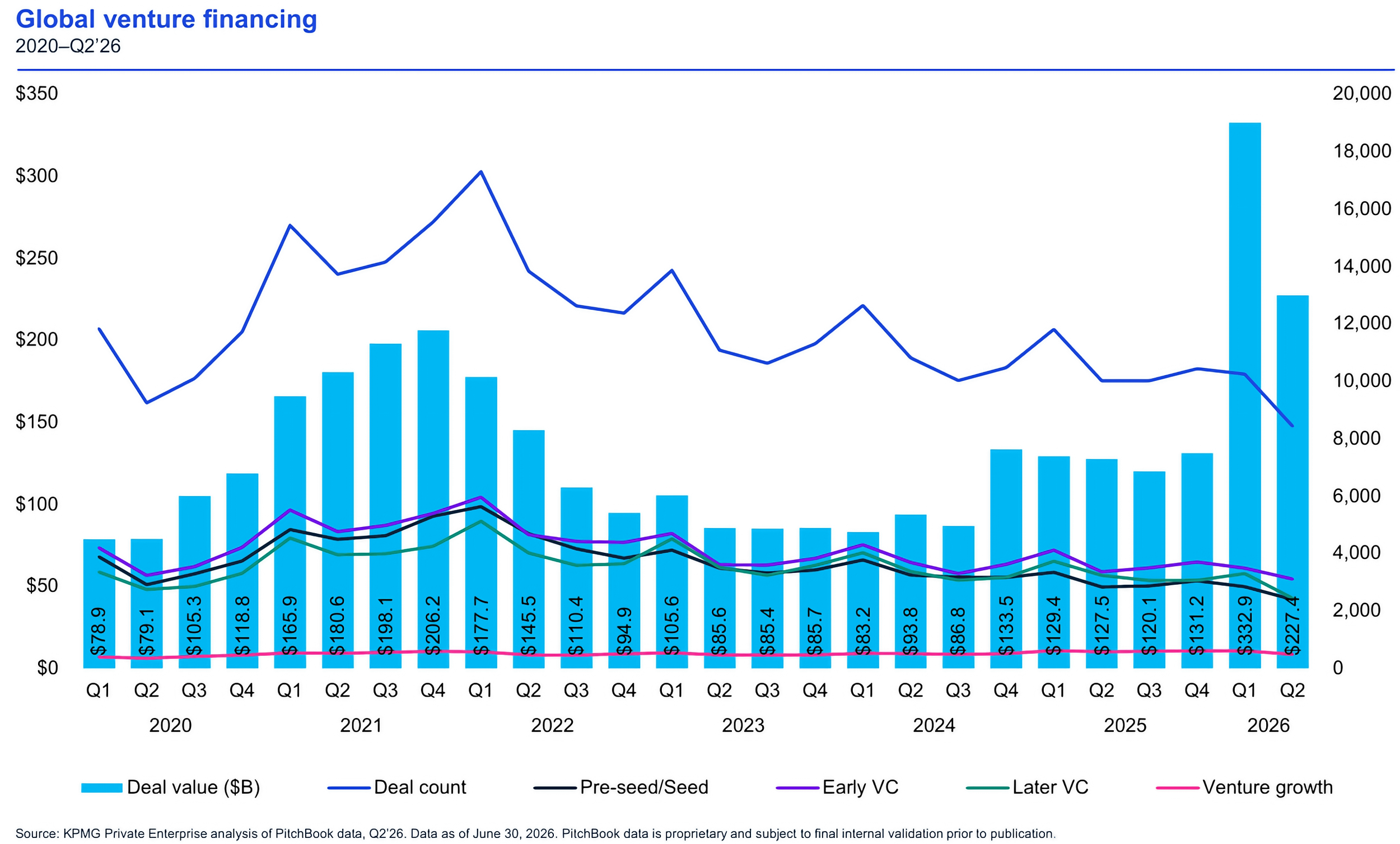
Two quarters into the year, global deployment stands at USD $560 billion. That already exceeds every full year of this decade except 2021's USD $751 billion, including all of 2025 at USD $508 billion. Anthropic's USD $65 billion round alone accounted for 29% of the Q2 global total.
In Q2 the Americas led with USD $150 billion across 3,999 deals, USD $145 billion of it in the U.S. Asia was the quarter's genuine improvement at USD $51 billion across 2,676 deals, its fourth consecutive quarterly gain. Europe held at USD $26 billion across 1,636 deals, which in a quarter this size counts as a result.
Outside the U.S. the largest bets are still AI bets and they are increasingly Chinese ones. DeepSeek raised USD $7.4 billion in a debut round structured to preserve founder control, ByteDance USD $3 billion, StepFun USD $2.5 billion and Moonshot AI USD $2 billion. Four of the five largest non-American rounds of the quarter were Chinese AI companies. The exception was Isomorphic Labs, which raised USD $2.1 billion for AI-driven drug design. European add-ons brought a British autonomous vehicle company to USD $1.3 billion and Sweden's Legora to USD $600 million. The American AI trade now has a Chinese counterpart of real scale, financed entirely outside the syndicates that price the American one.
The European round worth studying is the next one down. Ineffable Intelligence, a London reinforcement-learning laboratory founded in late 2025, came out of stealth in April with USD $1.1 billion at a USD $5.1 billion post-money valuation, co-led by Sequoia and Lightspeed with NVIDIA, Google and the United Kingdom's new Sovereign AI Fund. That was a seed round, and the largest in European history, raised by a company with no product, no revenue and no published roadmap, on the strength of its founder having led reinforcement learning at DeepMind. Early-stage capital is abundant for one very specific shape of founder, which is the argument I have been making about Canadian seed rounds for years, arriving at the opposite end of the scale.
Two sectors outside AI attracted real money on the strength of geopolitics rather than technology cycles. Defence technology stayed strong on sovereign capability programs, Anduril's USD $5 billion the largest round globally. Quantum computing has fallen off the record pace of 2025 without losing investor interest: Quantinuum raised USD $1.6 billion in a June Nasdaq listing at a USD $18 billion valuation, and Canada's Xanadu completed a USD $302 million reverse merger at the end of Q1, now trading on Nasdaq and the Toronto Stock Exchange, the closest thing to a Canadian liquidity event anywhere in this report. The binding constraint on most deep technology is duration rather than belief, and duration is exactly what a market with no distributions has least of.
State money was everywhere this quarter except where a deal tally would look for it, from Japan's further ¥150 billion into the chipmaker Rapidus to the United Kingdom's new £500 million Sovereign AI Fund, which appeared almost immediately in Ineffable's round. The Gulf looks absent from this quarter's global tallies, and that absence is an artifact of how it invested rather than evidence that it stopped. Saudi Arabia's HUMAIN put USD $3 billion into xAI in February, and that position converted into SpaceX equity when the two companies merged, which puts Gulf sovereign capital inside the largest exit in this report without appearing in a single Q2 financing table. Reading a quarterly deal tally as a measure of sovereign participation understates it by construction.
The global picture is the American picture at a different scale. AI megadeals in the U.S., China and Europe pull the top of the market to records while deal count and most non-AI sectors stay historically quiet. Concentration has become the operating condition of the asset class everywhere it is measured, rather than something the U.S. is exporting.
U.S. Digital Health Landscape
Two measuring sticks produced two different quarters. Rock Health, counting U.S. deals above USD $2 million, recorded USD $3.2 billion in Q2, down 24% sequentially. PitchBook, counting a broader global universe, recorded USD $2.7 billion, down 52%, even as deal count rose 43% year over year. More rounds; each one smaller. On PitchBook's numbers the entire sector is 1.2% of global venture dollars. Digital health is a rounding error in global venture, and has been for three years.

On a half-year basis the sector is up. U.S. digital health startups raised USD $7.4 billion across 244 deals in the first half, against USD $6.4 billion across 245 a year earlier: a 16% gain on identical deal volume. At that pace the full year lands near USD $15 billion, slightly ahead of 2025's USD $14 billion and the sector's best since 2022. Median deal size rose from USD $12 million to USD $14 million, also the highest since 2022, and the rise comes from larger companies being the only ones still able to close. The sector is not broadening; the survivors are being funded better.
Concentration is doing the rest of the work. Nineteen companies raised twenty rounds of USD $100 million or more, taking 45% of all capital in the sector, up from 42% in 2025 and 22% in 2024. Thirteen of the nineteen were first-time recipients of a round that size, which is legitimately healthy. Two of the rest came back inside a year: Garner closed a $100M Series E three months after a $118M Series D, and Aidoc took a second $150M cheque in under twelve. The largest rounds of the half were WHOOP at $575M, Verily at $300M, OpenEvidence at $250M, Talkiatry at $210M and eMed at $200M. Not one of the five is a point solution.
The quarter's most quoted number is also its most misleading. Commure did not raise USD $7 billion. It raised a USD $70 million venture growth round at a USD $7 billion post-money valuation, for a provider-facing agentic platform spanning intake, documentation, coding and revenue cycle management, used by more than 500 organizations including HCA Healthcare across more than 3,000 sites of care. The largest actual cheque of the quarter went to Forus, previously Tandem, at USD $160 million on a USD $1 billion post-money for agentic prescription access, followed by Assort Health at USD $120 million on a USD $1.2 billion post-money for AI voice agents, and by Chapter Medicare, Garner and Nourish at USD $100 million each. USD $7 billion made the headlines; the cheque was only 1% of it.
Rock Health retired a category this quarter, which matters more than any single financing. It has stopped labelling companies AI-enabled on the grounds that the technology is now ubiquitous enough that the label carries no information, and the operative question has shifted from who has AI to who has something that AI alone cannot supply. PitchBook describes the same shift from the buyer's side, with point solutions consolidating into end-to-end agentic platforms as providers stop buying features.
The four sources of durable advantage Rock Health identifies are deep founder domain expertise, ownership of more of the operating workflow, hands-on delivery through forward-deployed engineers, and compounding network effects. Three of the four take years and cannot be bought, which is the good news for anyone underwriting this sector. The moat in health technology is still located in the parts of the business that do not demo well.
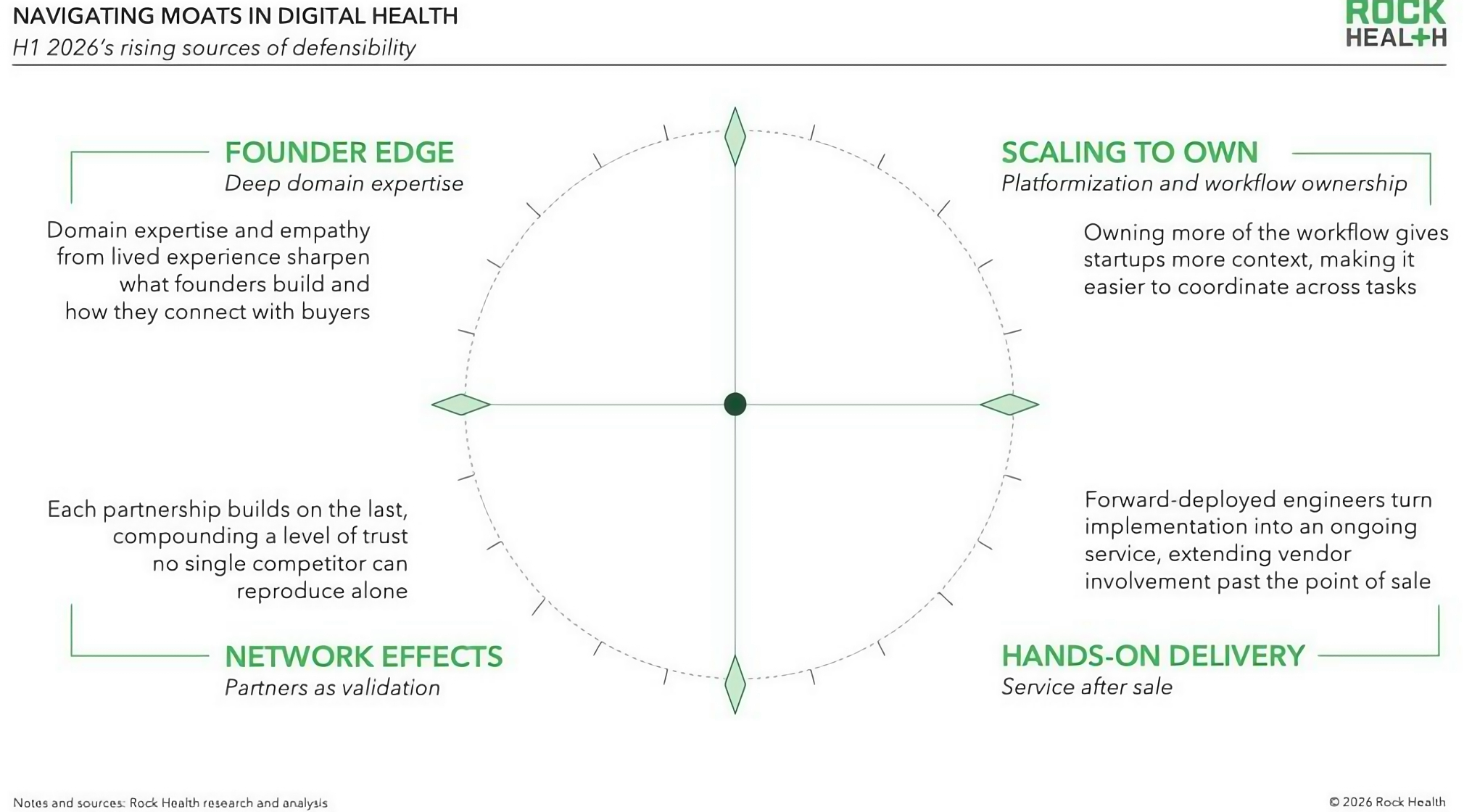
The workflow-ownership moat carries a risk I flagged in Q1 and would now weight more heavily. As vendors expand out of their original footholds to own more of the operating layer, their roadmaps begin to overlap with one another and with Epic's. Buyers who assembled a stack of specialists will increasingly find themselves evaluating redundant offerings, and the consolidation that follows will not be kind to the second and third products in any category. Many of them will end up as free features inside an incumbent's platform. In Q1 I wrote that we were watching which categories would keep independent distribution and which would become features of something larger; this quarter the answer started to arrive, and every early-stage health technology company now has to answer the oldest question in venture: is this a feature, a product or a company? The largest AI laboratories are already in the field, with Anthropic and OpenAI both building life sciences teams and sending forward-deployed engineers of their own. Platform consolidation risk is now the principal structural threat to early-stage health technology returns, ahead of reimbursement and ahead of regulation.
By clinical indication, mental health was the top-funded category for a seventh consecutive year, led by Talkiatry at $210M and Grow Therapy at $150M, with investors favouring purpose-built products carrying clinician oversight and third-party safety evaluation over general-purpose chatbots. Weight management was second, driven by the GLP-1 economy: eMed at $200M, Nourish and Midi at $100M each. A Medicare pilot offering GLP-1s at $50 per month opens a materially cheaper path for older patients. The two leading categories share a distribution pattern that separates them from the rest of the sector: 64% of the companies raising in them sell straight to the patient, more than twice the 29% rate across digital health. They are healthcare's cord-cutters, skipping the institutional buyer the way streaming skipped the cable bundle, and investors are paying a premium for the shortcut. That sits uncomfortably next to the moat argument in this section, and both things are true: the difficulty of selling into healthcare still protects the companies that get through it, and the money is increasingly going to the companies that never had to.
Exits stayed closed on the listing side and busy everywhere else. No digital health company has gone public this year, after seven exits in 2025. Oura is the sector's only listing candidate, on the back of the USD $900 million round it raised last October at a USD $11 billion valuation, still the largest digital health financing on record. Since quarter-end its filing has become public: it plans to list on Nasdaq under OURA, its prospectus shows USD $1.2 billion of nine-month revenue, up 74%, and a net profit, and reports put its target at up to USD $3 billion at a valuation above USD $16 billion, roughly 45% above that October round. How it prices is the cleanest read on this sector's exit window in two years. WHOOP's USD $575 million at USD $10 billion puts it behind Oura in the queue. GoHealth and Vicarious Surgical went the other way, both delisting in the half. The public market removed two digital health companies in the same six months it prepared to accept one.
Wearables have become plausible public companies in a way the Fitbit exit a decade ago was not. Consumer hardware is brutally hard, and harder still since Apple entered the category: Jawbone was liquidated, Pebble was sold for parts, and Fitbit ended up inside Google. Oura and WHOOP survived that, and the difficulty now reads as protection. In a year when public investors have been marking down B2B software on the fear that AI agents will do the work the software was sold to do, a device worn by five million paying members, with a subscription on top, looks like the more durable moat. It is healthcare's pattern in miniature: the hardest thing to build is the hardest thing to replace.
Mergers and acquisitions carried the liquidity. There were 115 acquisitions of digital health companies in the first half, 71 of them announced in Q2 alone, the busiest quarter since Q3 2021. Revenue cycle management was the hottest area of consolidation, including IKS Health's purchase of TruBridge and a USD $12 billion agreement by Thoreau Group to take control of Ensemble Health. Incumbents bought too: Roche acquired PathAI and Dexcom acquired Nutrisense. On PitchBook's global count, however, exit value fell 65% year over year and exits to private equity dropped to one in the quarter from eighteen in all of 2025. The volume is there and the value is not.
Among public comparables, Hinge Health more than doubled its offer price by the end of Q2 on first-quarter revenue of USD $182 million, up 47%, with a 23% free cash flow margin. Tempus reported 36% revenue growth. The sector's best public performers are the ones with proven unit economics rather than the ones with the best AI story, which is a useful corrective in a quarter when the private market priced the opposite.
Canadian Venture Capital Landscape
Canadian venture investment reached $2.7 billion across 250 deals in the first half of 2026, up 17% from $2.3 billion a year earlier. That is the first year-over-year increase in first-half capital since 2021 and it deserves the credit it will get. It is still a small number. Per person, Canada invested roughly USD $47 in the half against about USD $1,200 in the U.S., and even with every AI deal removed, the U.S. figure is more than three times Canada's. Deal count moved the other way, falling 9% from 274 to 250, the fifth consecutive first-half decline, though the smallest of the five. In Q2 on its own, 136 deals closed for $1.3 billion, a 7% decline in dollars against Q1 alongside a 19% increase in deal count. Across the half, though, fewer deals took more money, and that is the shape the rest of this section describes.

Now the part that matters more than the headline. Both ends of the Canadian pipe narrowed again.
At the bottom, seed financings totalled $285 million across 82 deals, down 31% in dollars and 13% in deal count against the first half of 2025. Pre-seed contributed $52 million across 56 transactions, an average round of $0.97 million. Together, pre-seed and seed accounted for $337 million, or 13% of all capital deployed in the half. In my Q1 report I noted that pre-seed and seed had reached a record 20% share of Canadian capital. That record did not survive the CVCA's restatement of the quarter, which added Beacon Software's $313 million Series C once it was announced in June; on the restated total the share was closer to 13%, and Q2 on its own came in near 12%. The record was an artifact of a missing round.
At the top, later-stage investment rose 23% in dollars to $984 million but did so across eighteen transactions, which is the lowest later-stage deal count in any first half in the CVCA series, on eight fewer deals than last year. Growth-stage activity amounted to $127 million across three transactions, most of it a single round. Eighteen later-stage financings in a country of 40 million people is not a stage of the market; it is a list.
The middle held, and held in the same way. Early-stage financings drew $1.2 billion across 68 deals, 44% of the half's capital and 29% more in dollars than last year, on an unchanged deal count. More money went to the same number of companies.
That is the early-stage narrowing these reports have tracked for years, now visible at both ends of the pipe, and this is the clearest version of it yet. Capital rose while the number of companies receiving it fell: seed contracted outright, pre-seed rounds are averaging under a million dollars, and the later-stage cohort is the smallest on record. The dollars went up and the shape of the market got worse. The cost of that shape arrives later; the companies that would raise Series A rounds in 2029 are the ones being seeded now, and fewer of them are.
Deal size says the same from the other direction. Sixteen rounds of $50 million or more closed in the half, totalling $1.6 billion, or 59% of all capital. Transactions below $25 million made up 85% of all disclosed deals and 32% of the dollars. Canada has the American barbell at roughly one two-hundredth of the scale, with very little bar between the weights.
Sector allocation produced the sharpest divergence in this quarter's entire source set, and it lands directly on our mandate. Information and communications technology drew $1.8 billion across 137 deals, 65% of capital, up 41% and the first first-half increase in the sector since 2021. It was the only sector to grow in both dollars and deal count. CleanTech was roughly flat at $336 million, anchored by Mangrove Lithium's $118 million round. Life sciences went the other way, falling 39% to $258 million across 49 deals, the lowest first-half total in the CVCA series; its largest financing was $54 million for Quebec's Congruence Therapeutics.
The capital stayed in the country and left the category. For a Vancouver health technology fund that is the single most important sentence in this report, and it cuts both ways. On paper, a category that capital has left should be cheaper to enter. In practice, founders are reading the same headline medians this report describes, assuming those medians apply to them, and pricing their rounds accordingly; survivorship figures that flatter the market are setting expectations for companies they do not describe. Meanwhile the later-stage syndicate that would carry a company from seed to Series B is the smallest in the CVCA series.
The largest disclosed financings of the half were Beacon Software at $313 million, Dominion Dynamics at $139 million, Koho Financial at $130 million and Mangrove Lithium at $118 million. BDC Capital participated in five of the top ten and was again the most active investor in the market, taking part in 34 rounds worth $832 million, nearly a third of all Canadian dollars in the half, well ahead of Inovia at 14 deals and Investissement Québec at 13. The top of the Canadian market has run through a federal balance sheet for at least a decade, and nothing in this half suggests that is changing.

Ontario, Quebec and British Columbia took 91% of dollars and 80% of transactions, led by Ontario at $1.1 billion, Quebec at $758 million and British Columbia at $570 million. Alberta fell to $158 million across 33 deals, against $467 million across 73 for all of 2025. Vancouver recorded $169 million across 29 deals and still finished behind Ottawa's $173 million across 10, on almost three times the deal count.
Venture rewards density, and this half's data says so on both sides of the border: the Bay Area took more than twice the rest of the U.S. combined, and Canadian money followed the same logic at a smaller scale. Canadian policy has often pulled the other way, spreading venture capital across the map as a regional development goal. That is a defensible aim for regional policy and a poor way to build venture returns in a country whose existing hubs are still too thin to carry their own companies to Series B. The more useful line in the federal government's new $1 billion Venture and Growth Capital Catalyst Initiative is its $200 million life sciences stream, aimed at precisely the category that just recorded its worst first half in the CVCA series.
Foreign participation firmed. U.S. investors took part in 28% of Canadian transactions, up from 26% in 2025 though still below the 32% of 2024 and the 37% peak of 2021. European participation reached 11%, the highest in the six-year series, while Asian participation slipped to 5%. Foreign money went to the largest rounds: General Catalyst took part in two deals worth $382 million, Mubadala Capital in two worth $225 million and Bessemer in two worth $160 million. Foreign capital is arriving at the top of the Canadian market and almost nowhere else in it.
Venture debt effectively stopped. First-half issuance totalled $276 million across eleven facilities, of which the first quarter accounted for seven and $256 million. The second quarter recorded four transactions totalling $20.7 million, the lowest quarterly total in the CVCA's records, with CIBC Innovation Banking the most active lender. A Canadian company that wanted non-dilutive growth capital in the second quarter of 2026 had almost nowhere to go.
Exits remain the unresolved problem. Disclosed value across venture-backed exits reached $716 million over 18 transactions, entirely through mergers and acquisitions. There were no initial public offerings, consistent with 2024 and 2025. Two and a half years without a Canadian venture-backed listing is long enough that it has stopped being a market condition and started being a planning assumption.
Capital Formation and Liquidity Cycle
U.S. venture funds raised USD $75 billion across 421 vehicles in the first half of 2026, against USD $76 billion across 939 vehicles for the whole of 2025. Nearly a full year of capital arrived in six months from fewer than half as many funds. That single comparison is the capital formation story of this cycle.
Funds of USD $1 billion or more took 68% of all capital raised against 36% in 2025, while growing from 1.4% to 4% of all funds with disclosed value. At the firm level the concentration is starker: twelve firms that closed USD $1 billion or more in aggregate commitments this year accounted for 75% of every dollar raised. The Venture Monitor's narrower count puts Andreessen Horowitz at USD $14 billion across seven funds, Founders Fund at USD $11 billion across two and Thrive Capital at USD $10 billion across two, which is USD $35 billion, or 48% of the half, from three firms. Limited partners did not select four hundred managers this half; they selected three and rounded.
The mirror image is what is happening to everyone else. Funds below USD $50 million now represent 68% of all funds closed and 4% of capital raised, their absolute count falling from a 2022 peak of 779 to 285 this half. First-time fund formation hit a decade low. Small managers are squeezed from both directions: limited partners are consolidating around brand-name relationships, and large multistage funds increasingly write the seed and Series A cheques that used to be the reason to back a dedicated early-stage vehicle at all.

Limited partners are behaving this way for the same reason they behaved this way last year and the year before, and the reason is cash rather than sentiment. The twelve-month venture distribution yield stands at 12% to 13% of net asset value against a long-run average of 19%; the 2021 vintage has produced the lowest five-year distributions-to-paid-in multiple of this century. This is the fifth consecutive year in which the asset class has returned less to its investors than its own history says it should, and I have flagged it in every one of these reports for years.
The returns picture that sits on top of that is the most useful analysis in this quarter's source set, and it needs to be read carefully because the headline is flattering. U.S. venture posted a one-year internal rate of return (IRR) of 17% through the end of 2025, ahead of private capital's 6% and roughly in line with the S&P 500's 18%. On that number alone venture looks recovered. The three-year and five-year horizons tell a different story at 6% and 8%, against 25% and 17% for the index. The one-year number is the one that will appear in fundraising decks; the three-year number is the one that describes the decade.
The mechanism behind the gap is worth stating: total U.S. venture net asset value grew 22% to USD $1.2 trillion in 2025 while distributions stayed below their long-run average. Horizon IRR captures both realized and unrealized value, so a year in which marks rise and cash does not will produce exactly this result. The 17% is an AI markup rather than a distribution. The three- and five-year figures still contain the 2022 and 2023 downturn and will improve mechanically as those quarters roll out of the window, which is not the same as the asset class improving.
Vintage returns need reading with the J-curve in mind. Every vintage in PitchBook's table is measured at December 31, 2025, so the 2025 funds are less than a year old and a median IRR of minus 2% is what a first year looks like rather than a verdict. The more useful number in that row is the gap between weighting methods: 24% when funds are weighted by size, minus 16% when each fund counts once, so the early gains belong to the largest funds. Dispersion is real in vintages old enough to have been tested; the 2023 vintage, two years in, shows a top decile of 46% against a median of 17%.
Fund size split the results sharply. Over one year, funds below USD $250 million returned 3% against 18% for larger funds; over three years, 0.4% against 6%. That gap is the clearest reason limited partners keep moving their money to larger managers. It also has an uncomfortable explanation: much of the large funds' lead comes from owning stakes in the handful of companies marked up hardest in 2025, Anthropic, OpenAI and SpaceX among them, and those gains are still on paper.
The cost of manufacturing a large exit has risen while the reward has fallen. The median company exiting above USD $500 million this year had raised USD $324 million, more than double the USD $157 million of a decade ago, while median exit size has moved less than 15% and the valuation step-up at exit has collapsed from 63% in 2021 to 16%. More capital in, the same money out. Large exits have justified venture risk for 40 years, and the arithmetic behind that justification is weakening.
Meanwhile the backlog keeps growing. There are more than 950 unicorns in the U.S. and 113 new billion-dollar valuations created this year alone, against fewer than 50 venture-backed listings in any year since 2022. Eleven unicorns including SpaceX have gone public this year, the highest count since 2021 and still far below the rate at which new ones are created. Median time to exit has stretched to 5.1 years, and longer still for unicorns. The queue is lengthening faster than the door is widening.
Secondaries are filling part of the gap, unevenly. Trailing twelve-month direct venture secondaries are running at roughly USD $100 billion, a figure that leans heavily on SpaceX, OpenAI and Anthropic. A secondary market that can move stakes in the handful of companies large enough to matter is useful without being a distribution engine for the asset class. Private credit and secondaries have both become substitutes for going public rather than bridges to it.
The loop closes on itself. Poor distributions narrow limited partner allocations; narrower allocations concentrate capital in the largest managers. Those managers write the largest cheques into the largest companies, which produces net asset value growth rather than cash, which keeps distributions poor. Every turn makes the next one tighter, and nothing in this quarter's data interrupts it. What would interrupt it is a broad exit market, and what we got was one company that builds rockets.
For a fund of our size and mandate the implications are direct. The thin syndicates that limit our companies also limit funds like ours: until distributions broaden beyond a handful of names, the capital that would back smaller sector-specific vehicles has nowhere to come from, which makes this a structural constraint on health technology fundraising rather than a cyclical one. The arithmetic in this market supports two positions only: discipline on entry price, and reserves sized for longer holds.
Looking Ahead
Four variables will decide whether the second half confirms this quarter or breaks it. The first is whether the exit market produces a second act, and the answer arrives sooner than a quarterly report usually allows. Anthropic filed confidentially on June 1 and is targeting a Nasdaq listing in October, with a public registration statement expected around the time this report reaches you. OpenAI filed a week later and has since signalled it may wait until 2027. Whatever multiple public investors assign Anthropic in October becomes the denominator in every model written for OpenAI, and for every late-stage AI mark in between. Cerebras and SpaceX are both cautionary: one priced at five times its prior year's valuation and now trades below its offer, the other is a third below its high with its venture lock-ups still unexpired. Oura will have priced before the Anthropic roadshow begins. Two listings within weeks of each other, one consumer health device and one AI laboratory, will tell us more about the depth of this window than Q2's headline exit number did.
The second is whether the floor under the market keeps dropping. Rounds below USD $100 million fell to 13% of U.S. venture dollars from 33% a year earlier and 44% the year before, and digital health shows the same compression from the other side. Against that, first-time financings are on pace for a record year above 10,000 companies. The two facts are not contradictory: it is cheap to start a company and expensive to grow one, and the gap is where a generation either gets funded or does not. If the second half confirms the trend, the right description is a missing middle rather than a lull between megadeal cycles.
The third is whether valuations set on cheap capital survive expensive capital. Median Series D and later pre-money valuations more than doubled in a single year, the AI premium at that stage reached 6.6 times, and median Series B and later valuations have now surpassed 2020, 2021 and 2022, the three years that produced the highest late-stage loss ratios of the past decade. All of that was priced in the same quarter the Federal Reserve's median projection flipped toward a hike, and the committee meets days after this report reaches you to decide whether to deliver one. Companies that raised at those prices on compressed timelines need to grow into them quickly or face a down round, and the time between rounds has shortened most for exactly the AI companies carrying the highest marks. Whether that pricing holds, or whether the reversal begins showing up as flat and down rounds at the top of the market, matters more than any deal count.
The fourth is closest to home. Canadian seed dollars fell 31%, pre-seed rounds are averaging under a million dollars, the later-stage cohort is the smallest on record, and life sciences investment hit a series low in the same half that information and communications technology posted its first gain since 2021. Canada is short of both capital and breadth, and this half the second shortage got worse. If the second half repeats the pattern, the narrowing I have been describing for years will have run through another full year without a single quarter of reversal, and the consequence lands in 2029 rather than now.
If 2021 rewarded velocity and 2023 rewarded survival, I wrote in Q1 that 2026 is rewarding scale and specificity. Half a year on I would sharpen that. What 2026 is rewarding is proximity: to the few companies, the few managers and the few square miles between Sand Hill Road and downtown San Francisco where the capital has decided to live. Proximity is a real advantage and it is also the least durable one on the list, because it depends entirely on the capital continuing to agree about where to stand. The companies that will still be worth owning when it stops agreeing are the ones solving problems that were hard before the capital arrived and will still be hard after it leaves. In healthcare, fortunately, that is most of them.
